
The best way to store an extension ladder in a garage is usually on its side, flat against a wall, with the top rail resting on steel hooks screwed into studs. Space the hooks so the ladder is supported about every 6 feet. It stays off the floor, out of the walkway, and out of tipping range. Here's how to set that up, which hooks to use, and the mistakes worth avoiding.
Horizontal vs. Vertical Ladder Storage
Most ladder safety guidance points to horizontal storage. Canada's national workplace safety agency recommends storing ladders flat on racks or mounted on a wall rather than standing upright, with support about every 6 feet so the ladder doesn't sag.
In most garages, horizontal storage wins for three reasons:
It won't fall on anything. A ladder leaned upright in a corner is one bump away from landing on a hood, a windshield or a kid.
It uses dead wall space. A side wall above the workbench is usually empty.
It's easy to get down. You lift it off the hooks instead of digging it out from behind the mower.
Vertical storage can work for a short ladder if it's strapped to the wall. Ceiling racks free up the most room but mean lifting the ladder overhead every time, which is a poor trade for a ladder you use often.
How Many Hooks an Extension Ladder Needs
Start with two measurements before you buy anything.
Collapsed length. With the sections nested, an extension ladder is a little over half its listed length. Measure yours end to end.
Stacked depth. Measure across both rails with the sections nested. That's how much reach the hooks need when the ladder hangs on its side.
Then plan the hooks:
Spacing: aim for a support point about every 6 feet, with a short, even overhang at each end.
Shorter ladders: two hooks is a reasonable starting point if the ladder is under about 12 feet collapsed.
Longer ladders: plan on three, one near each end and one in the middle, so the center doesn't bow over time.
Stud math: most garage walls are framed 16 inches on center, so a hook on every fourth stud lands them 64 inches apart.
How to Hang a Ladder on a Garage Wall
Pick the wall. A side wall, clear of the overhead door track, your car doors, and the water heater or furnace.
Find the studs. Use a stud finder and mark each stud you plan to use. If the wall is OSB or plywood over studs, the hooks still need to go into the studs behind it.
Mark a level line. Around chest to shoulder height keeps the ladder out of the way without overhead lifting.
Mount the hooks. Drive the included hardware through both holes in the mounting plate and into the stud.
Set the ladder on its side. With a helper for anything long, lift the ladder so the top rail rests on the hooks and the rungs stand vertical against the wall. Slide it until the overhang is even on both ends.
Check it. The ladder should sit flat without rocking. If kids play in the garage, a strap or bungee around the ladder and one hook adds peace of mind.
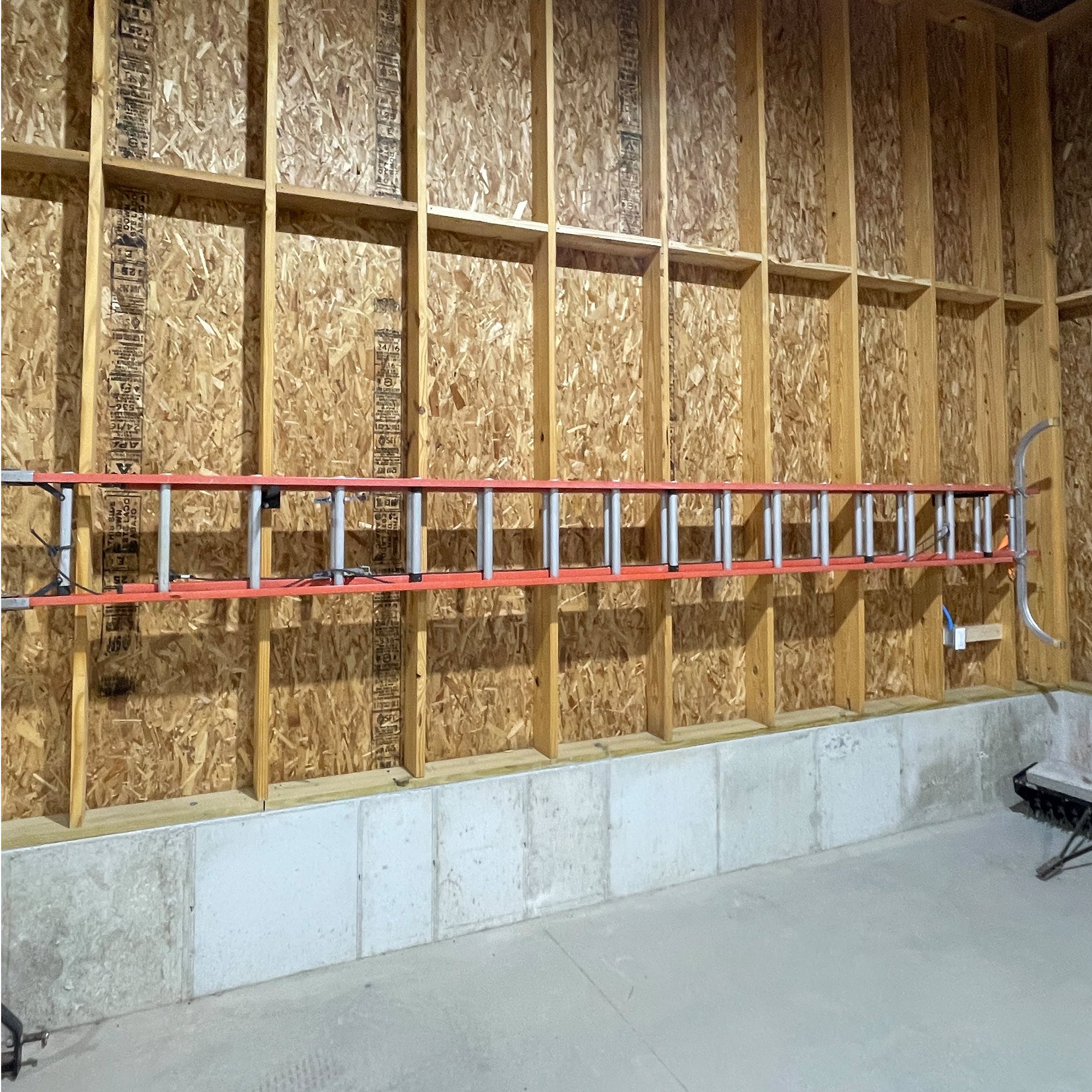
Customer install
Choosing Ladder Hooks: Reach, Steel and Finish
Reach. The hook has to be longer than the ladder is deep. The 12" Single Prong ladder hook gives 12 inches of reach, enough for a single extension ladder hung on its side. The 20" ladder hook gives 20 inches, which leaves room for a second ladder, a step ladder alongside, or coiled hose and cord on the same hooks.
Steel and mounting. Look for solid steel tube rather than stamped sheet metal or plastic, and a plate that bolts into a stud. Our Single Prong racks are 1" square, 16-gauge American steel tube welded to a 4" × 4" plate with two holes for a single stud. Mounting hardware comes in the box.
Finish. Snowmelt dripping off a truck in a Michigan January will find any bare steel in the garage. Every Single Prong is powder coated black, which adds real durability over bare or painted steel. It's the detail customers tend to notice first.
Every rack is welded and assembled in Grand Rapids, Michigan. If you're doing the rest of the wall while you're at it, our wall-mount tool racks cover shovels, rakes and long-handled tools, and there's free shipping on Log Claws and Tool Racks over $125.
Ladder Storage Mistakes to Avoid
Hanging it from one rung. A ladder hung vertically by a single rung puts its whole weight on one point and can swing into whatever walks past. Resting it on its side across several hooks spreads the load along the rail.
Storing it near heat. Keep fiberglass ladders away from furnaces, water heaters and wood stoves, and inspect any ladder that's been near high heat before you climb it.
Parking it in a sunny window. UV light breaks down the resin in fiberglass over time. A shaded wall is the better spot.
Leaving it on the floor. It's a trip hazard, it sits in damp (hard on wood ladders), and it ends up buried.
Using it as a shelf. Weight piled on stored rails can bend or crack them.
For the rest of the garage, see how to organize a garage, our guide to wall mount tool storage, and how to store garden tools. Picking rack sizes for tools? The tool rack buying guide breaks down 6", 12" and 20".
Frequently Asked Questions
Should a ladder be stored horizontally or vertically?
Horizontal is generally the safer choice for an extension ladder. Stored on its side on wall hooks, it's far less likely to fall and stays supported along its length. Vertical storage can work for a short ladder if it's strapped to the wall.
How far apart should ladder hooks be?
A common guideline is to support a ladder about every 6 feet so it doesn't sag. On a wall framed 16 inches on center, a hook on every fourth stud puts them 64 inches apart. Longer extension ladders usually call for three hooks.
Is it okay to store a ladder outside?
Inside or under cover is better. Sunlight breaks down the resin in fiberglass ladders over time, and moisture is hard on wood ladders. If a ladder has to live outside, keep it under a roof, off the ground and out of direct sun.
What size ladder hook do I need for an extension ladder?
Measure how deep the ladder is with both sections nested, then pick a hook with reach to spare. A 12-inch hook fits a single extension ladder stored on its side. A 20-inch hook leaves room for a second ladder or a step ladder alongside it.
Can I hang a ladder on drywall without hitting a stud?
It isn't recommended. A ladder hook holds its load out away from the wall, which puts leverage on the fasteners, and drywall anchors can pull out. Mount each hook into a stud, even if the wall is covered in OSB or plywood.
Can I store a step ladder the same way?
Yes. Fold it and rest it on its side across a pair of hooks, the same way you'd store an extension ladder. A 20-inch hook can hold a step ladder alongside an extension ladder on the same wall.
